Gower Gold
Red-billed Choughs on Gower's Cliffs


The red-billed chough (Pyrrhocorax pyrrhocorax) – that charismatic corvid with its glossy black plumage, curved red bill, and acrobatic flight – holds a special place in Welsh coastal ecology and my heart. These birds are the essence of wild coastlines: clifftop specialists that nest in sea caves and rock crevices, feeding in the short grazed turf above the cliffs where they probe for beetles, spiders, and other invertebrates.
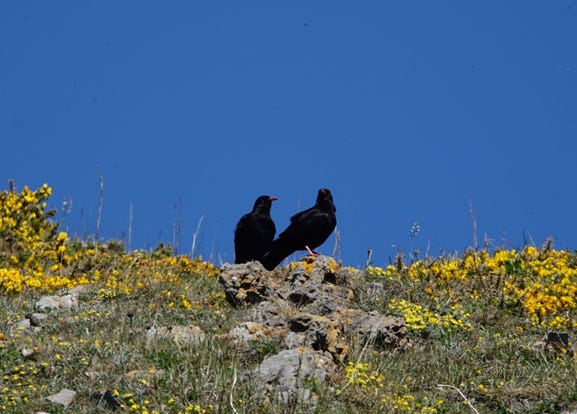
For the first time, the newly formed Gower Chough Group (Mike Shewring, Joey Pickard, Sam Tillet, Aaron Davies) has completed a systematic breeding season survey across the Gower Peninsula, documenting every sighting and assessing breeding success at potential nest sites. The findings paint a picture of a small, resilient population – but one facing pressures.
What We Found
Over the 2025 breeding season, we recorded 134 chough observations across Gower’s coastline. From these, we confirmed breeding at three sites, all in the southwest: around Rhossili, Mewslade, and Port Eynon. At least two territories successfully fledged young, with 2-3 chicks heard at Rhossili and a single large chick observed at Mewslade.
One of the breeding males at Mewslade carried colour rings from when he was ringed as a chick back in 2015, by me! We can’t be sure he is the same bird as in the ten years since I ringed him he’s lost two of the three colour rings making identification more complicated. But on the balance of probability its most likely to be him – the evocatively named ET43052, Rt: Purple stripes/BTO Lt: Yellow/Green. It was truly lovely to re-encounter him.
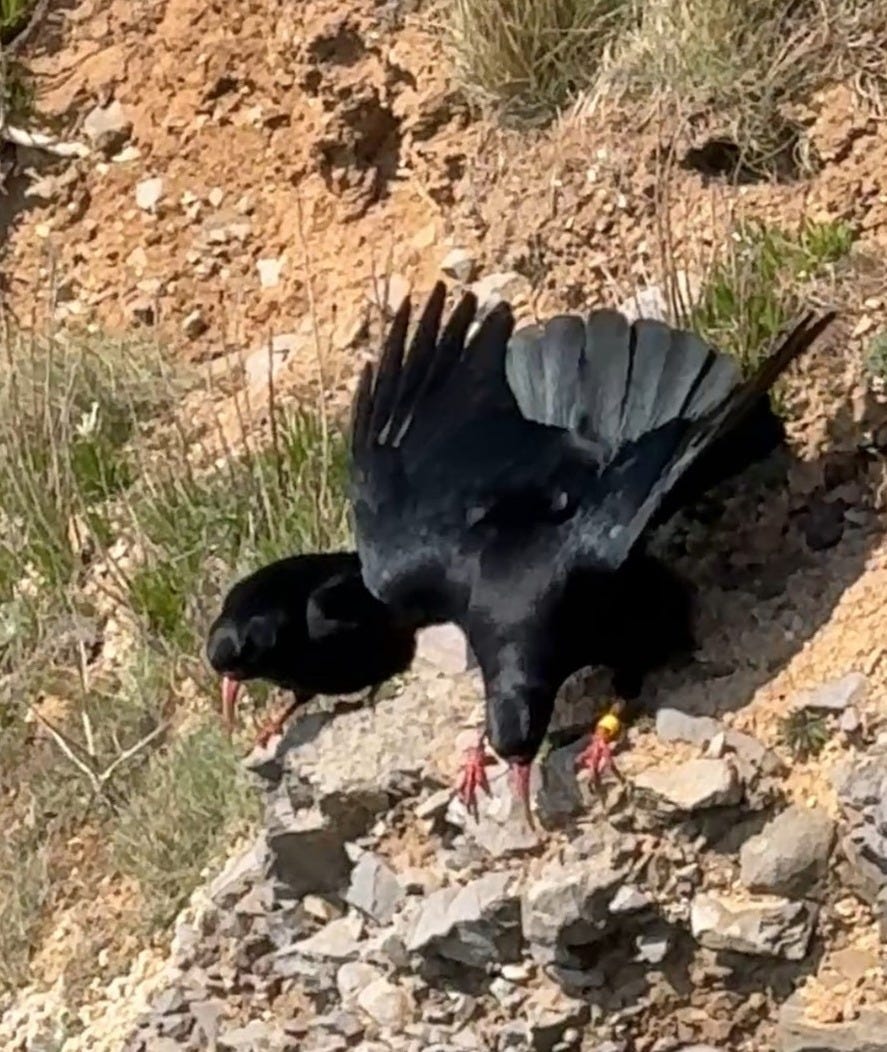
This decade of site fidelity speaks to how these birds bond to specific stretches of coast. This local recruitment is heartening; it suggests the Gower population isn’t just holding on through immigration from elsewhere, but is successfully producing its own next generation.
Many of the chough along the Welsh coastline are colour ringed, especially in Ceredigion and North Wales, by the tireless efforts of Adrienne Stratford and Tony Cross. The Cross & Stratford partnership project has colour ringed over 5,000 choughs, and there have been approximately 30,000 individual re-sightings reported. This re-sighting data has shed light on the movements, social and nesting behaviour of chough, and has also given insight into life expectancy and survival rates. The results of the study have been used to inform the selection of sites for designation and agri-environment agreements aimed at protecting and conserving chough in Wales. One of the most successful colour ringing projects ever in Wales!
If you find a colour-ringed chough, please send your sightings to Adrienne Stratford (adriennestratford@btinternet.com). Adrienne will ensure the relevant details are sent to the BTO.
But back to 2025: three confirmed pairs is not a large population. And worryingly, the eastern section of Gower around Southgate – where choughs have nested historically – showed no confirmed breeding in 2025 (although there were sightings of juveniles in June 2025 in this area – which could mean we missed a nest). We observed paired birds feeding on the ground there, suggesting multiple territories were occupied, but we couldn’t locate active nests. Either breeding didn’t occur, or nests failed early before we could confirm them.
So what’s going on at Southgate?
Here’s where the picture darkens. All four documented disturbance events during the 2025 breeding season occurred in the Southgate area. Dog walkers, climbers, and coasteering groups were all recorded disturbing choughs near known or potential nest sites during the critical April-May breeding window.
This pattern can’t be ignored. The successful breeding sites are in the less-accessible western cliffs; the areas with confirmed breeding failure or non-attempts are precisely where human recreational pressure is highest. Choughs are sensitive to disturbance during incubation and early chick-rearing, and even well-meaning walkers or climbers can cause nest abandonment if they approach active sites too closely or too frequently.
I want to be clear: this is based on a single season’s data, so we can’t definitively say that disturbance is limiting or even significantly impacting Gower’s chough population. But the circumstantial evidence is strong enough to warrant concern and, crucially, action.
Why Choughs Matter
Choughs are a Red List species in the UK, having contracted to coastal strongholds in Wales, Scotland, Ireland, and Cornwall after historical declines linked to agricultural intensification and habitat loss. The Gower population forms part of a wider Welsh coastal meta-population, providing connectivity eastward along the Glamorgan Heritage Coast. Lose the Gower birds, and you fragment that network.
But beyond their conservation status, choughs are ecosystem indicators. They need extensive areas of short coastal grassland maintained by grazing, bare ground patches where invertebrates thrive, and undisturbed cliff sites for nesting. If choughs are struggling, it signals broader issues with coastal habitat management and access pressure.
What Needs to Happen
The good news is that the solutions are straightforward – if stakeholders are willing to act: better communication with site users at Southgate about chough sensitivity to disturbance, and access management around sensitive sites.
Crucially, we really need long-term monitoring using consistent methodology that will build the dataset we need to track population trends and link outcomes to management interventions. This year’s survey provides the baseline; annual repetition will reveal whether the population is stable, declining, or recovering. So if anyone fancies funding our planned 2026 survey (or some of it) please get in touch!
The monitoring framework is ready. The conservation actions are clear. The question is whether we’ll act in time – and whether Gower’s choughs will still be here to benefit
Mike Shewring led the 2025 Gower Chough Survey as part of the Gower Chough Group. This piece represents my own views and does not represent the views of the RSPB.
The correlation between human disturbance at Southgate and breeding failure is pretty striking tbh. Its interesting how the western cliffs with less access had sucessful nests - makes you wonder if we need seasonal access restrictions during breeding season like they do with seal colonies. The fact your building a baseline dataset is crucial though, one season isn't enough to make policy but it's a strong start.